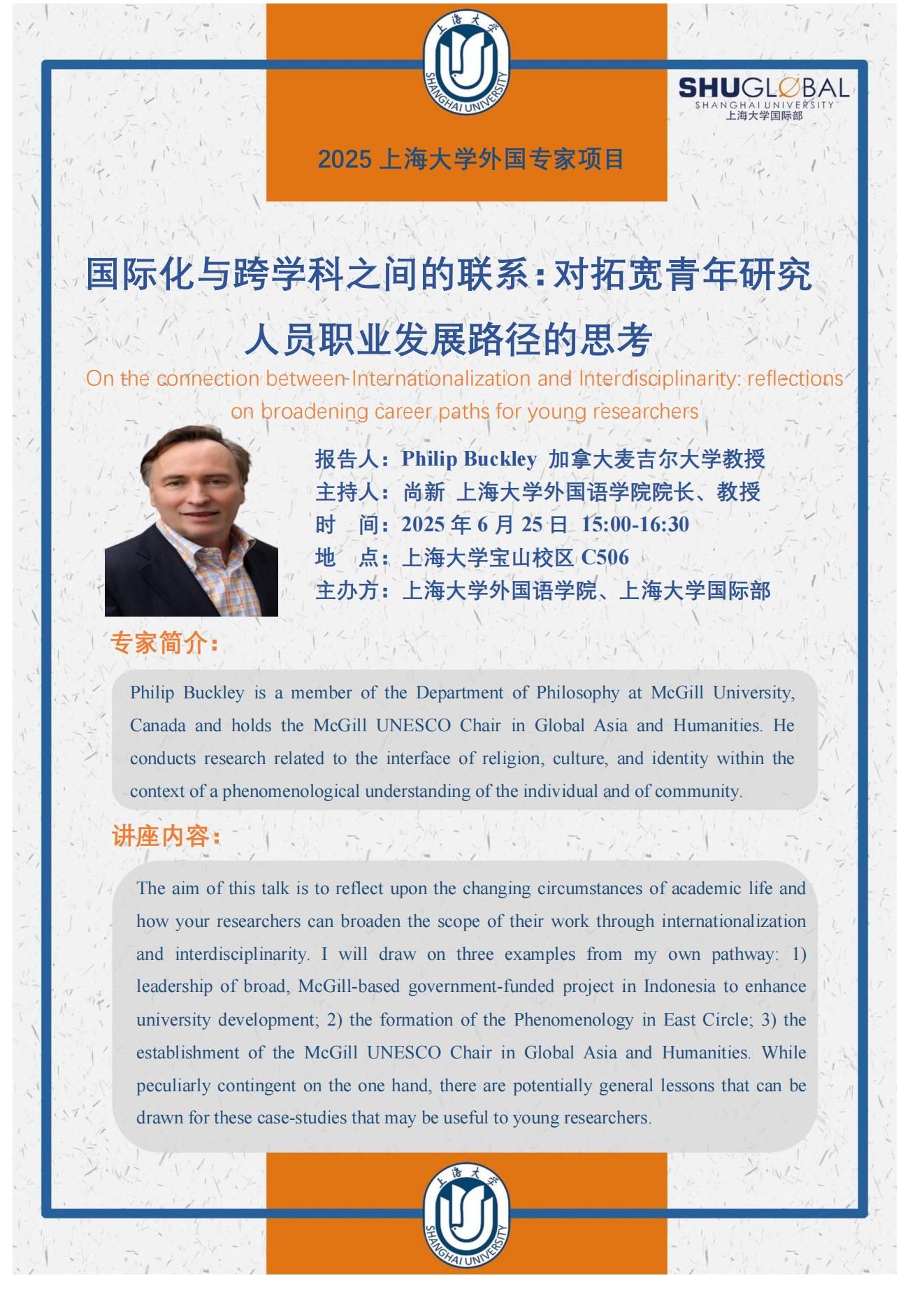
汇报人:Philip Buckley加拿大麦吉尔大学教授
主持人:尚新CA88表国语学院院长、教授
时 间:2025年6月25日15:00-16:30
地址:CA88宝山校区C506
主办方:CA88表国语学院、CA88国际部
专家简介:Philip Buckley is a member of the Department of Philosophy at McGill University, Canada and holds the McGill UNESCO Chair in Global Asia and Humanities. He conducts research related to the interface of religion, culture, and identity within the context of a phenomenological understanding of the individual and of community.
讲座内容:The aim of this talk is to reflect upon the changing circumstances of academic life and how your researchers can broaden the scope of their work through internationalization and interdisciplinarity. I will draw on three examples from my own pathway: 1) leadership of broad, McGill-based government-funded project in Indonesia to enhance university development; 2) the formation of the Phenomenology in East Circle; 3) the establishment of the McGill UNESCO Chair in Global Asia and Humanities. While peculiarly contingent on the one hand, there are potentially general lessons that can be drawn for these case-studies that may be useful to young researchers.